
In March, the Pan-Canadian Women’s Health Coalition co-hosted Vitally Important: National Women’s Health Summit in Toronto. Over 370 experts, advocates, community leaders and women with lived experience came together to tackle the issues that most affect women’s health through panels, talks and collaborative sessions that highlight the science, stories and solutions driving progress.
Join the Pan-Canadian Women’s Health Coalition as well as trainees and early-career investigators across our network for a two-part program focused on mentorship, career development and collaboration.
The session will kick off with a panel discussion exploring key challenges faced by trainees and early-career researchers, along with successful and innovative approaches to mentorship and career advancement. The program will then transition into a virtual networking session, where participants can reflect on panel insights, share their own work, and connect with peers and established researchers and leaders in the field. Organized around shared research interests and areas of expertise, this interactive segment is designed to foster community, encourage peer support and spark new cross-hub collaborations in women’s health research.
Want to be on the list? For more information please contact [email protected].
Breastfeeding, lactation or chest feeding provides important health benefits to mothers and infants. Breastfeeding rates in Manitoba, particularly in Indigenous people living in remote regions, were substantially lower than the general population. Colonialism, socioeconomic, geographic barriers, lack of perinatal education and support contributed to the difference. The education or support on infant feeding to gender diversified people are inappropriately low in the province. This project, led by Dr. Garry Shen, aims to develop a community-based multi-sector infant feeding support strategy and facilitate trauma-informed, culturally safe and gender-inclusive perinatal education and support for urban-, rural or remote-living perinatal parents in Manitoba.
Cervical cancer is the fourth leading cause of cancer-related deaths among women worldwide, despite the availability of highly effective preventive measures. Dr. Karen Yeates has been a leading investigator in projects employing mobile health (mHealth), artificial intelligence (AI) and telemedicine to improve cervical cancer screening accuracy and accessibility. Her collaborations include the PAVE (HPV–Automated Visual Evaluation) Consortium, a multi-country study combining self-collected HPV testing, extended genotyping and AI-assisted image analysis to identify cervical precancer (CIN3+).
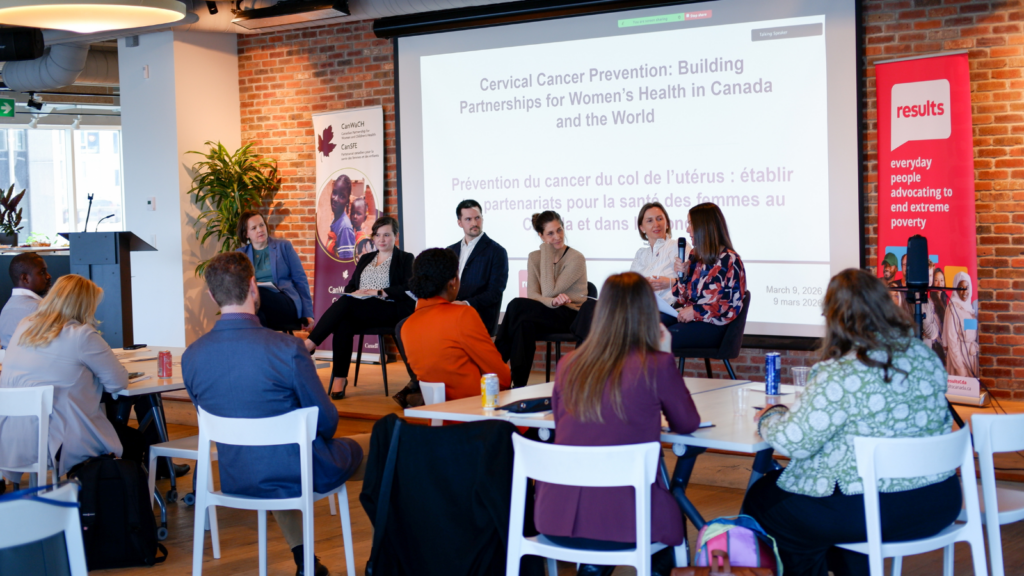
This project will establish a community-led, community and health system-based program of research that will bring PAVE 2.0 to remote and rural Indigenous communities in Northern Ontario, Canada. This research work is in its early pre-implementation phases and is expected to begin in the second quarter of 2026. On the heels of International HPV Awareness Day and International Women’s Day, Dr. Yeates spoke at a CanWaCH and Results Canada roundtable discussion with Canadian policymakers, representatives from global health initiatives, academics and civil society organizations on the importance of a multi-sectoral approach to eliminate cervical cancer in Canada and around the world.
This project addresses a critical gap in early detection of developmental dysplasia of the hip (DDH) in Canada. DDH is a common yet poorly understood condition in which a newborn’s hip socket does not form properly. It is known to disproportionately affect female and Indigenous infants. Early detection, within the first three months of life, is essential since the hip is still soft cartilage and can be treated with a simple harness. Delayed diagnosis, after six months of life, often requires surgical intervention and can result in premature hip osteoarthritis.
Dr. Jacob Jaremko and his research team has developed a simplified ultrasound protocol that uses artificial intelligence to instantly interpret ultrasound scans to identify early signs of hip dysplasia. This device has been developed so that minimally trained users can use it effectively, thereby increasing the accessibility of DDH screening.
Women spend a large portion of their lives in a postmenopausal state, yet the biological consequences of estrogen loss remain poorly understood. Menopause is associated with increased risk of conditions such as metabolic dysfunction, cardiovascular disease, osteoporosis and cancer, but current approaches largely focus on managing symptoms rather than preventing disease. A major gap in women’s health research is understanding how estrogen deprivation contributes to biological aging processes that may drive postmenopausal syndrome and long term disease risk. This project addresses that gap by investigating cellular aging as a unifying mechanism linking menopause to adverse health outcomes.
Dr. Anne-Marie Mes Masson and her team focuses on understanding how the menopausal transition can dramatically reshape female physiology at the tissue level and why these changes can set the stage for disease later in life. By recognizing menopause as a distinct biological process, this research takes an important step forward in improving how we identify risk and support healthier aging for women.
Genitopelvic pain (pain in the genital/pelvic areas) affects up to 28% of assigned females. People with genitopelvic pain, including provoked vestibulodynia (PVD), often face barriers to seeking care, such as long wait times, cost, and stigma or discomfort associated with discussing vulvar pain. An accessible online option like PelvicSense may offer meaningful support while individuals are waiting for care, alongside usual care, or in situations where specialized care is not readily available.
PelvicSense is a virtual program that provides education and skills through modules focused on pain science, mindfulness and pelvic floor exercises — approaches that have shown benefit for people with genitopelvic pain, including PVD. In our pilot study with individuals with PVD, PelvicSense demonstrated promising improvements in pain and other important outcomes. Dr. Caroline Pukall and her team are conducting a randomized controlled trial for provoked vestibulodynia (PVD) examining the effectiveness of the PelvicSense program.
Submit your Hub updates or activities by the 15th of each month to be featured in our newsletter! Submissions can be made through our intake form or by contacting Deborah Dahan, Manager of Evidence in Action. You can also add events to our calendar at any time.
Let us know what your Hub is up to — we would love to highlight your work!
Please invite all members of your Hub, community partners, or others who may be interested to sign up for this newsletter here and be sure to follow us on LinkedIn and Bluesky.